121 King Street, Melbourne , Australia
800.567.1234
121 King Street, Melbourne , Australia
800.567.1234
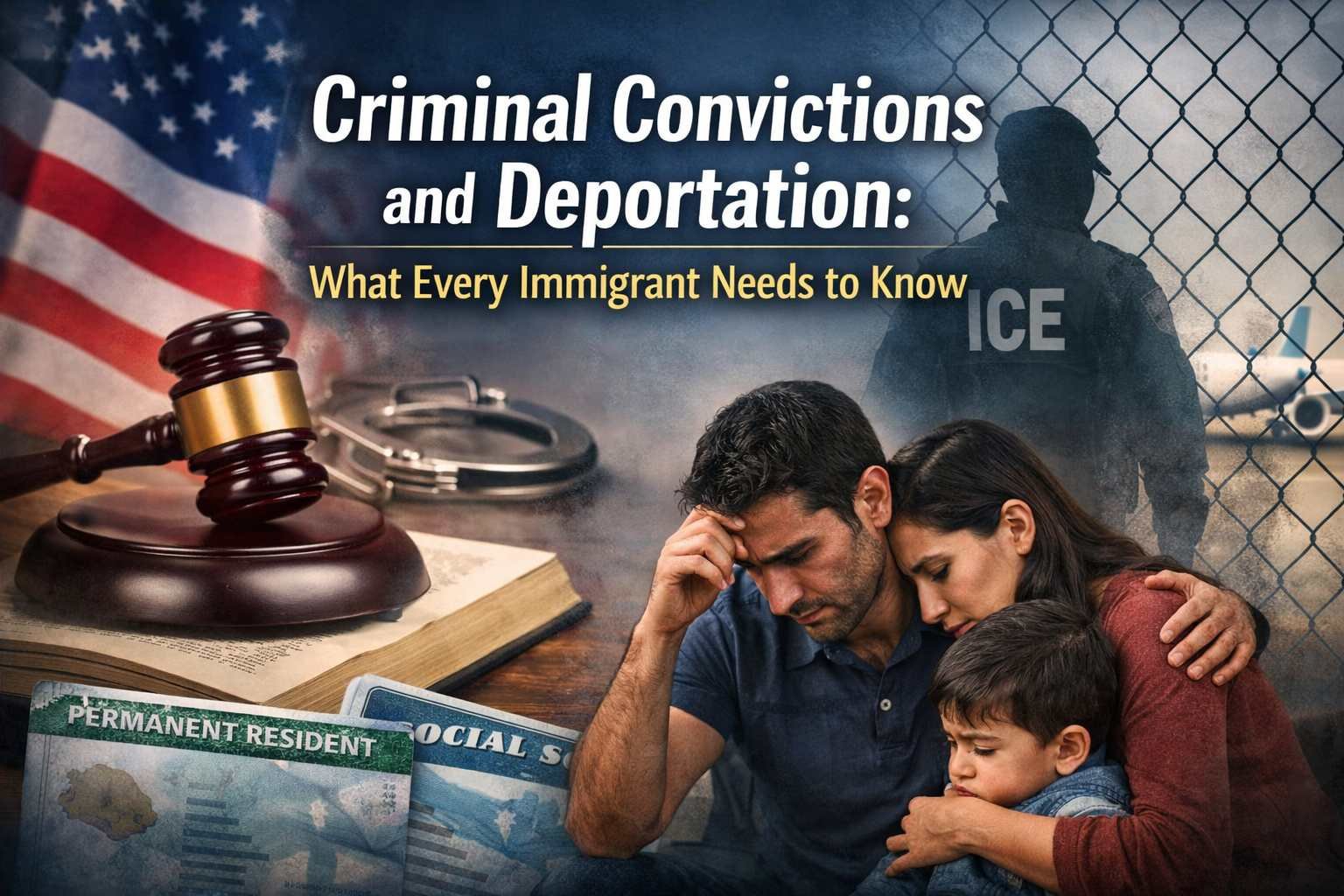
For many immigrants, the biggest shock comes after the courtroom.
You might think:
· It’s just a misdemeanor.
· I didn’t serve jail time.
· The judge gave me probation.
But immigration law does not follow criminal court logic. A plea that seems “safe” in state court can still trigger ICE involvement, block a green card application, or lead to removal proceedings years later.
Immigration consequences can arise under two separate frameworks:
· Deportability (you already have lawful status and the government seeks to remove you)
· Inadmissibility (you are applying for a benefit, reentering the U.S., or adjusting status and the conviction blocks approval)
The same conviction can create problems under both systems.
Under U.S. immigration law, certain convictions can make a person deportable. Some of the most common categories include:
· Aggravated felonies
· Crimes involving moral turpitude (CIMTs)
· Controlled substance offenses
· Domestic violence-related convictions
· Multiple convictions with certain sentencing structures
Let’s break these down.
“Aggravated felony” is a technical immigration term. It includes many offenses that may not seem aggravated—or even felonies—under state law.
Examples can include:
· Theft offenses with a one-year sentence (even if suspended)
· Drug trafficking offenses
· Fraud involving more than $10,000
· Certain crimes of violence
For green card holders, an aggravated felony conviction can trigger deportation and eliminate many forms of immigration relief—including cancellation of removal for lawful permanent residents.
The label matters more than the name of the crime.
“Moral turpitude” generally refers to crimes involving dishonesty, fraud, or intent to seriously harm someone.
Common examples can include:
· Theft or shoplifting
· Fraud or identity theft
· Certain assault offenses
· Some domestic violence-related convictions
A single CIMT committed within five years of admission—if the offense carries a possible one-year sentence—can create deportability issues. Two CIMTs at any time can also trigger removal.
There is a narrow “petty offense” exception, but it is technical and heavily fact-dependent.
Some long term residents have a hidden problem they do not even know exists, an old removal order.
This often happens when someone was given a court date years ago and never received the notice, never understood it, moved, or was too afraid to attend. If the court ordered removal “in absentia,” that order can stay on your record for decades.
If ICE detains someone with a prior removal order, the case can move much faster, and bond may be harder or impossible in many situations. There may still be options, like filing a motion to reopen, especially if proper notice was never received, but it is time sensitive and complex.
If you suspect you ever had a past immigration case, it is worth speaking with a qualified attorney and checking your records before there is an emergency.
Many clients ask: “What about my specific charge?”
Below are some of the most common California statutes we see in immigration cases.
In California, DUI charges commonly fall under:
· Vehicle Code § 23152(a) – Driving under the influence
· Vehicle Code § 23152(b) – Driving with 0.08% BAC or higher
If there is an allegation of injury, prosecutors often file:
· Vehicle Code § 23153 – DUI causing bodily injury
Important: A simple DUI is not automatically a deportable offense in every situation. However, DUI cases can become immigration-dangerous depending on injury, prior convictions, related charges, or how the statute is interpreted. Never assume a DUI plea is immigration-safe without review.
Common California domestic violence statutes include:
· Penal Code § 273.5 – Corporal injury to a spouse or intimate partner
· Penal Code § 243(e)(1) – Domestic battery (spouse/cohabitant/dating partner)
Immigration law has specific domestic violence deportation grounds. These cases are particularly dangerous because immigration courts may rely on the conviction record—not just what actually happened.
Even reduced or misdemeanor pleas can have serious consequences.
Controlled substance offenses are among the harshest in immigration law.
Common California statutes include:
· Health & Safety Code § 11350(a) – Possession of specified controlled substances
· Health & Safety Code § 11377(a) – Possession of certain controlled substances
· Health & Safety Code § 11364(a) – Drug paraphernalia
Even if California law has become more lenient, federal immigration law has not. A drug conviction can trigger deportation and block many immigration benefits.
There is a narrow exception for a single offense involving possession for personal use of 30 grams or less of marijuana—but it is highly technical and does not make drug pleas generally safe.
Hit-and-run charges can also raise immigration concerns:
· Vehicle Code § 20002 – Property damage hit and run
· Vehicle Code § 20001 – Hit and run involving injury or death
Immigration consequences may depend on whether injury occurred and what was admitted in the plea record. These cases require careful legal analysis before any plea is entered.
Immigration law looks closely at:
· Number of convictions
· Sentence length (including suspended sentences)
· Whether offenses are considered CIMTs
Even if each individual offense seems minor, multiple convictions can combine to create deportability.
And yes—suspended sentences count for immigration purposes.
Criminal convictions can affect:
· Green card holders
· DACA and TPS recipients
· Asylum seekers
· Undocumented individuals
· Applicants for naturalization
Many people are blindsided years later—during a green card renewal, naturalization application, or after a completely unrelated arrest.
Sometimes the best defense is going back to criminal court to fix the conviction.
One of the most important California tools for immigrants is:
· Penal Code § 1473.7
This statute allows a person who is no longer in custody to move to vacate a conviction if prejudicial legal error damaged their ability to meaningfully understand or defend against the immigration consequences of their plea.
Post-conviction relief can include:
· Vacating a conviction
· Withdrawing an immigration-unsafe plea
· Modifying a sentence to avoid aggravated felony classification
We regularly evaluate whether older pleas can be challenged to protect a client’s immigration future.
If someone is already in removal proceedings, cancellation of removal may be available.
INA § 240A(a) (8 U.S.C. § 1229b(a)) generally requires:
· 5 years as a green card holder
· 7 years of continuous residence after admission
No aggravated felony conviction
INA § 240A(b) (8 U.S.C. § 1229b(b)) generally requires:
· 10 years physical presence
· Good moral character
· No disqualifying criminal convictions
· “Exceptional and extremely unusual hardship” to a U.S. citizen or LPR spouse, parent, or child
These cases are evidence-heavy and fact-specific—but for the right person, cancellation can mean staying with your family instead of being deported.
If you are not a U.S. citizen:
1. Do not plead guilty before speaking to an immigration attorney.
2. Get copies of all criminal paperwork.
3. Confirm the exact statute number.
4. Ask whether the sentence length affects immigration consequences.
5. Avoid international travel if your record is unresolved.
6. Take ICE detainers seriously.
The decision you make in criminal court can determine whether you remain in the United States.
Yes. Many deportable offenses are misdemeanors under state law.
Yes. Immigration law treats suspended sentences as real sentences.
Not always—but certain DUI convictions can create serious immigration problems.
Yes. Old convictions often resurface during green card or citizenship applications.
It depends on the offense. Some crimes bar relief entirely; others may allow waivers.
You may still have defenses, including cancellation of removal or post-conviction relief.
Immigration consequences don’t always appear immediately.
People often discover the danger years later—when applying for a green card, naturalization, DACA renewal, or after a routine traffic stop.
If you or a loved one is facing criminal charges or already has a conviction, don’t guess.
The Law Office of Daniel S. Castaneda, APC helps immigrants understand what’s at stake, coordinate with criminal defense attorneys, pursue post-conviction relief when appropriate, and fight removal in immigration court.
Your future in the United States may depend on what you do next.
The Law Office of Daniel Stefan Castaneda is always there to protect your rights. Give us a call at 619-710-6095, reach out via contact form here, or send a mail to daniel@castalegal.com
Copyright ©2022 Lawyer