121 King Street, Melbourne , Australia
800.567.1234
121 King Street, Melbourne , Australia
800.567.1234
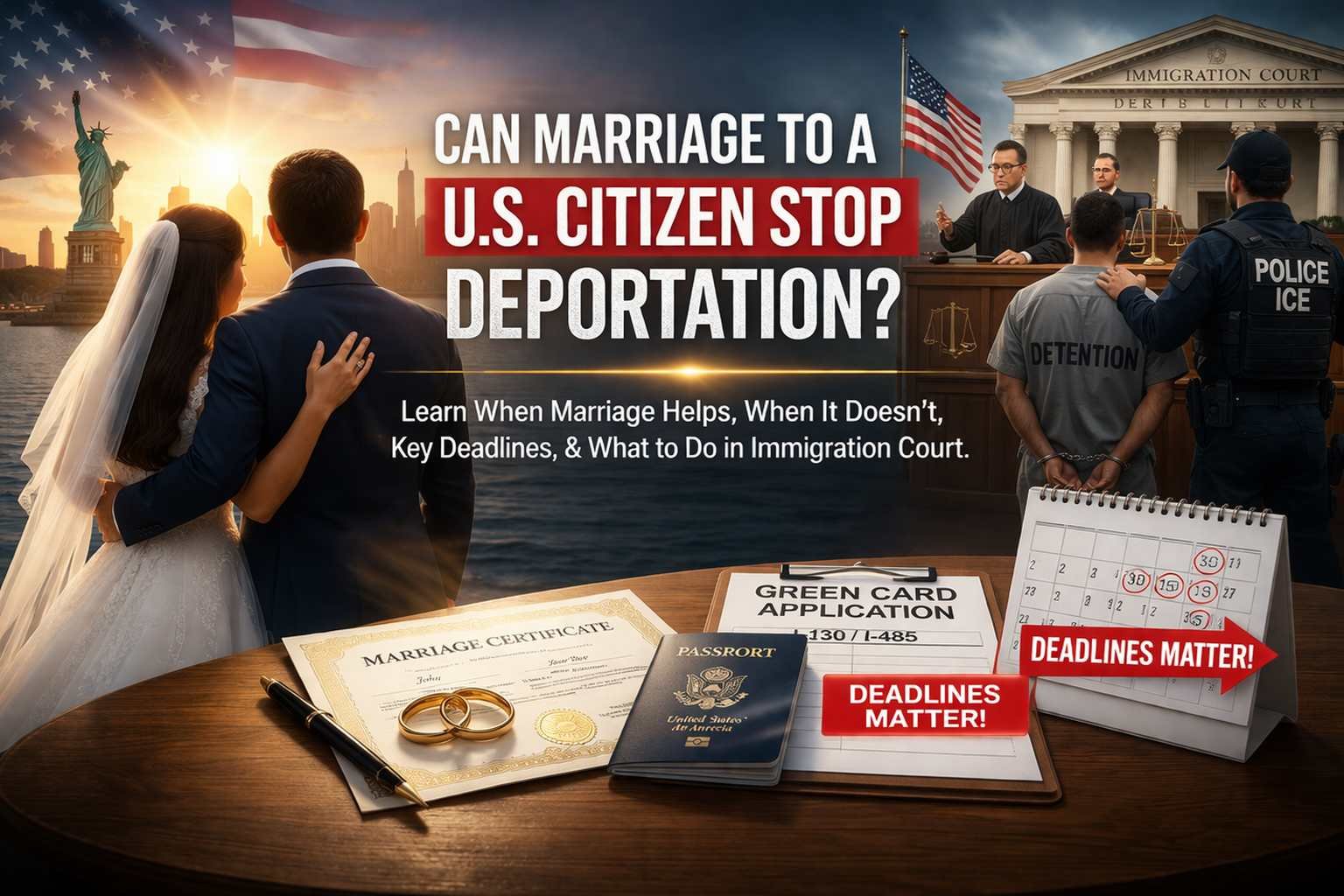
If you or someone you love is facing deportation, one of the first questions that comes up is simple and urgent: Will marrying a U.S. citizen stop removal?
The honest answer is: sometimes marriage can help a lot, but it does not automatically stop deportation. That distinction matters.
We talk to families all the time who assume a wedding certificate fixes everything. It does not. Marriage can open a legal path to a green card, but immigration court does not stop just because a couple gets married. You still have to qualify, file the right applications, meet the deadlines, and present the case the right way. In some situations, marriage is the beginning of a solution. In others, it helps, but only if waivers, reopening, or consular processing are handled carefully. (USCIS)
At The Law Office of Daniel Stefan Castaneda, we believe people deserve straight answers, not false hope. So here is the real-world version of how marriage-based relief works when deportation is on the table.
A U.S. citizen can file Form I-130 for a spouse, and spouses of U.S. citizens are considered immediate relatives under immigration law. That is important because immediate relatives are not subject to annual visa caps the way many other family categories are. But filing or even approving the I-130 does not give the immigrant spouse legal status by itself. USCIS says that plainly: the filing or approval of the petition does not, by itself, give immigration status or benefits. (USCIS)
That means someone can still be in removal proceedings, still be detained by ICE, and still be at risk of deportation while the marriage-based case is pending. Marriage creates an opportunity. It does not create automatic protection. (USCIS)
This is where many cases are won or lost.
If the noncitizen spouse was inspected and admitted or paroled into the United States, they may be able to apply for adjustment of status here in the U.S. USCIS’s policy manual is clear that, as a general rule, adjustment requires inspection and admission or parole. (USCIS)
That rule matters because many people assume marriage to a U.S. citizen wipes out an unlawful entry. It does not. If someone entered without inspection (EWI), they usually cannot adjust status inside the United States unless a narrow exception applies, such as eligibility under INA § 245(i) or another special provision. (USCIS)
On the other hand, if someone entered with a visa and overstayed, marriage to a U.S. citizen may still allow them to adjust status in the United States because certain bars for being out of status do not apply to immediate relatives of U.S. citizens. (USCIS)
That is why two people can both be married to U.S. citizens and have completely different outcomes.
Once removal proceedings have started, the marriage case is no longer just a USCIS filing issue. The immigration judge now matters too.
Usually, the U.S. citizen spouse files the I-130 with USCIS first. If that petition is approved, the person in removal proceedings may then try to pursue adjustment of status before the immigration judge, assuming they are otherwise eligible. But the court case does not disappear automatically while that is happening. (USCIS)
This is one of the most stressful parts for families: court deadlines keep coming while USCIS processing is happening on a separate track.
If your address changes while you are in proceedings, EOIR requires you to update the immigration court within five working days using the appropriate change-of-address form. Missing notices because you moved and failed to update your address can create very serious consequences. (respondentaccess.eoir.justice.gov)
And if someone already has a final order and needs to reopen the case, the general rule is that a motion to reopen must be filed within 90 days of the immigration judge’s final order, though there are important exceptions in some cases. (Department of Justice)
This is another area where people are often surprised.
When a marriage happens after removal proceedings begin, immigration law applies extra scrutiny. USCIS policy requires clear and convincing evidence that the marriage was entered into in good faith and not to evade immigration law. (USCIS)
That means this is not the kind of case you want to “wing.”
You should expect to prove the relationship with real evidence, such as:
A real marriage can absolutely succeed in immigration court. But a weak file can create unnecessary problems.
This is where many families need a careful strategy instead of assumptions.
If the immigrant spouse cannot adjust status inside the U.S., the case may require consular processing abroad. That often raises a second issue: unlawful presence bars. In some cases, a person may need an I-601A provisional unlawful presence waiver before leaving for the immigrant visa interview abroad. USCIS explains that this process is for certain immigrant visa applicants who are relatives of U.S. citizens or lawful permanent residents and need a waiver of unlawful presence before departing the United States for consular processing. (USCIS)
This is where timing becomes critical. Families often want to know, “How long will this take?” The honest answer is that it varies widely by form type, case type, and adjudicating office. USCIS says its processing-time tool reflects how long it took to complete 80% of adjudicated cases over the last six months, so timelines can move up or down. (USCIS)
That uncertainty is exactly why families need a realistic plan before anyone leaves the United States or makes a move in court.
Another common misunderstanding is that marriage “forgives” everything. It does not.
If someone has certain criminal convictions, prior removals, fraud or misrepresentation issues, or unlawful entry problems, they may need one or more waivers in addition to the marriage case. USCIS makes clear that Form I-601 is used to seek a waiver of certain grounds of inadmissibility, and that waivers requiring a showing of extreme hardship are handled through the I-601 or I-601A process depending on the issue. (USCIS)
And if someone already has a final removal order, getting married does not erase it. Reopening the case may still be necessary, and the timing rules can be strict. (Department of Justice)
This should go without saying, but it needs to be said plainly: do not enter a sham marriage for immigration purposes.
USCIS policy is explicit that marriages entered into for the purpose of evading immigration laws are not recognized for immigration benefits. USCIS also continues to work with law enforcement on marriage-fraud investigations. (USCIS)
A rushed marriage is not the same as a fake marriage. Real couples often move up wedding plans because of immigration pressure. But if the relationship is not genuine, the damage can be permanent.
Sometimes, yes. But not by itself.
Marriage can be powerful when:
Marriage is much less effective when:
In other words, marriage may be part of the answer, but it is rarely the whole answer. (USCIS)
If you or your spouse is in removal proceedings, do not wait for the next court date to “see what happens.” Use the time now.
A smart first step is to gather the facts that will shape the case:
Then get legal advice quickly. Not after a denial. Not after an in absentia order. Not after ICE shows up. Early advice matters because immigration cases often turn on strategy, timing, and documentation.
At The Law Office of Daniel Stefan Castaneda, we help families look at the full picture: adjustment of status, motions to reopen, waivers, consular processing, court strategy, and the practical steps that need to happen now, not six months from now.
If you are reading this because your family is scared, here is the most important thing to remember: marriage can help, but hope needs a plan.
Some marriage-based deportation cases succeed. Some do not. The difference often comes down to whether the case was analyzed honestly and handled carefully from the beginning.
If you want a clear assessment of your options, The Law Office of Daniel Stefan Castaneda can help you understand where you stand and what steps make sense next.
Disclaimer: This article is for general information only and is not legal advice. Immigration law changes often, and outcomes depend heavily on the facts of each case. (USCIS)
The Law Office of Daniel Stefan Castaneda is always there to protect your rights. Give us a call at 619-710-6095, reach out via contact form here, or send a mail to daniel@castalegal.com
Copyright ©2022 Lawyer